
The Liquidity Paradox: Why Having Cash Doesn’t Always Mean Having Liquidity
A business can have millions sitting in its bank accounts and still find itself scrambling to meet a payment. Sounds familiar?
Well, it sounds contradictory, yet it is a reality for many businesses.
It happens when the money on the books does not translate into funds that can be accessed and deployed where they are needed. The issue may not be how much cash the business holds. It may be where that cash sits, what it is already committed to and how clearly the finance team can see the full picture.
Because having money is one thing. Knowing what you can do with it is another.
When Cash and Liquidity Tell Different Stories
Cash is what a business holds. Liquidity is its ability to meet financial obligations as they fall due.
The distinction matters, particularly for businesses operating across multiple bank accounts, subsidiaries, countries and currencies. A company may have a healthy aggregate cash balance but still struggle to meet an immediate obligation because its funds are not readily accessible, are held in the wrong currency or have already been earmarked for other commitments.
Consider a business with surplus funds in one account and an urgent supplier payment due from another. The money exists, but accessing or repositioning it may require additional coordination, conversion or processing time.
In other situations, the challenge is less about access and more about information. When balances and transactions are spread across different banking relationships and reporting systems, establishing an accurate picture of the business’s financial position can become a task in itself.
This is the liquidity paradox: a business can have substantial financial resources without having the immediate flexibility it needs to use them effectively.
The Hidden Cost of Not Knowing Where Your Money Stands
When treasury teams lack a clear view of their cash position, the consequences can extend beyond inconvenient reporting.
- Unnecessary borrowing: A business may seek external funding to cover a short-term obligation while funds elsewhere in the organisation remain underused. The additional financing cost may be avoidable if the business can identify and mobilise suitable available funds in time.
- Idle cash: Money sitting in one account may remain underutilised while another part of the business faces a funding requirement. Without a consolidated understanding of balances and commitments, opportunities to allocate resources more efficiently can be missed.
- Delayed decisions: If finance teams must manually gather information from multiple sources before assessing their position, decisions about payments, funding and cash allocation can take longer than necessary.
- Limited foresight: A snapshot of current balances cannot, by itself, reveal how upcoming receipts, payments and other obligations will affect future liquidity. Without reliable forecasting, a business may find itself reacting to funding pressures that could have been anticipated.
For treasury leaders, the challenge is not simply to keep track of cash. It is to understand what that cash can support, when it can support it and what the business needs to prepare for next.
From Cash Visibility to Better Treasury Decisions
A clear view of cash is the starting point, not the destination.
Effective treasury management requires businesses to understand their current financial position, anticipate upcoming obligations and coordinate resources accordingly. That means looking beyond individual account balances to consider the bigger picture.
Where is the business holding its funds? Which obligations are approaching? What currencies will those obligations require? Which balances are available for deployment, and which are already committed?
Answering these questions helps treasury teams move from simply reporting financial information to using it to inform decisions.
It also changes the role of treasury within the wider business. Rather than spending valuable time piecing together fragmented information, finance teams can focus more attention on evaluating funding needs, managing exposures and supporting strategic priorities.
For growing businesses, especially those operating across borders, this visibility becomes increasingly important as financial relationships and obligations grow more complex.
The objective is not merely to see more numbers. It is to understand what those numbers mean for the decisions ahead.
Bringing Your Treasury Operations Into One View
As businesses grow, their treasury operations can become increasingly distributed across accounts, currencies, banking relationships and workflows. When these activities are managed in isolation, getting a clear picture of the overall position can require considerable coordination.
A more connected approach can help reduce that fragmentation.
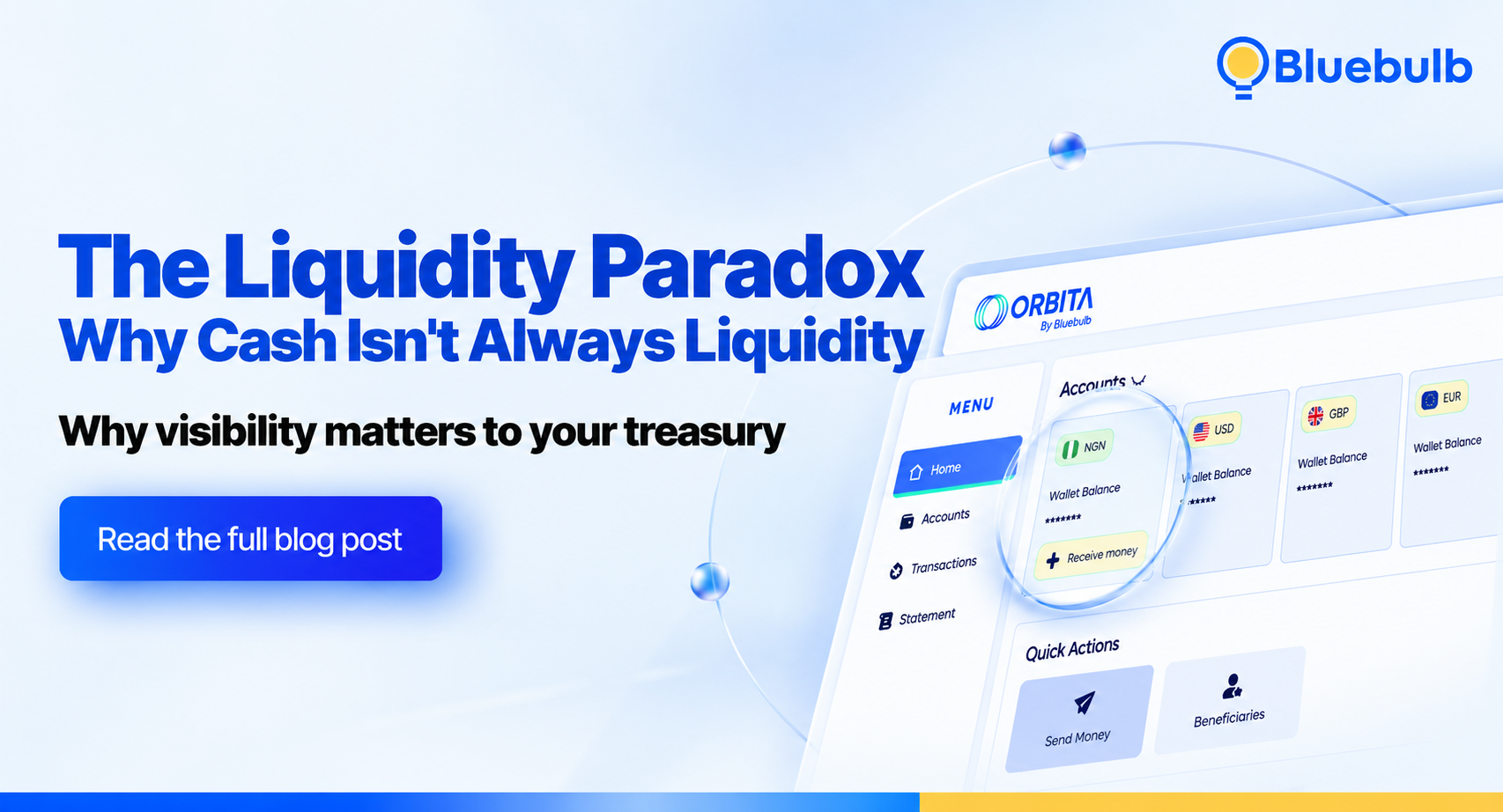
This is where Orbita, Bluebulb’s Treasury Operating System, comes in.
Orbita brings key treasury activities into one dashboard, helping businesses gain greater visibility and control over their treasury operations. With capabilities including multi-currency wallets, global payment initiation and transaction tracking, it supports a more coordinated approach to managing financial activity.
Rather than navigating disconnected workflows to understand individual transactions, businesses can use Orbita to manage key treasury activities in one place.
Because when treasury information is easier to access and understand, finance teams are better positioned to focus on what matters: making informed decisions about the money the business has and the obligations it needs to meet.
Cash Is King. Visibility Is What Makes It Count.
A strong cash position gives a business options. But those options are only useful when the business can understand its financial position and act within the constraints of timing, access, currency and existing commitments.
The question, therefore, is not just how much cash your business holds. It is how clearly you can see it, how confidently you can plan around it and how effectively you can put available resources to work.
Explore Orbita and take a more connected approach to managing your treasury operations.